


Manufacture
Explore our packaging factory, production equipment and rigid box manufacturing operations.
Explore Manufacturing
 Folding Rigid Boxes
Space-saving rigid packaging designs.
 Packaging Tube Boxes
Distinctive cylindrical paper packaging.
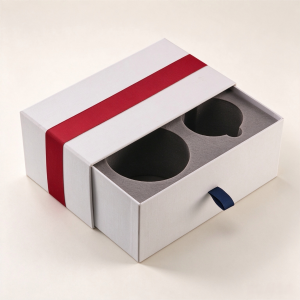 Drawer Boxes
Elegant sliding drawer box structures.
 Magnetic Closure Boxes
Premium boxes with secure magnetic closure.
 Advent Calendar Boxes
Multi-compartment seasonal gift packaging.
Explore our packaging factory, production equipment and rigid box manufacturing operations.
Explore Manufacturing
Discover our workflow from structural development and sampling to printing, assembly and quality control.
Explore Our Capabilities
Learn about responsible material choices, recyclable packaging design and reducing unnecessary material use.
Explore SustainabilityMost packaging disasters are not manufacturing failures. They are approval failures — a defect that existed in the pre-production sample, was not on anyone's checklist, and became a claim three thousand units later. The inspection that matters happens before the run starts, not at the end of it.
This is a pre-production audit sequence for rigid boxes and folding cartons, written from the buyer's side of the table. It assumes you already know which AQL level you are working to; if not, start with our explanation of AQL 1.5 versus AQL 4.0. What follows is the order in which to check things, and the specific points where paper boxes actually fail.
Rule one
Inspect the first article, not the last. A defect found after 500 units are glued is a rework decision; found after 5,000 it is a negotiation. Every checkpoint below should be signed before the next production stage starts.
Production runs in stages, and each stage locks in a decision that is expensive to reverse later. Checking after the fact is what "quality control" usually means in practice — and it is the expensive version.
| Stage | What locks in | Check before moving on |
|---|---|---|
| 1. Dieline & white sample | Structure, dimensions, closure | Product fits; lid closes square; interior depth clears the insert |
| 2. Printed proof | Colour, artwork position, copy | Colour against the approved reference under agreed lighting |
| 3. Material in | Board grade, wrap paper, insert stock | Board thickness and grammage against spec; wrap shade against the reference sheet |
| 4. Cutting & grooving | Cavity accuracy, fold lines | Groove depth; no fibre break on the fold; cavity within tolerance |
| 5. Forming & wrapping | Corner geometry, wrap tension, alignment | Corners square; wrap joins hidden; no bubbles or lifting |
| 6. Finishing & packing | Foil, emboss, magnet fit, carton count | Registration, magnet strength, unit count per carton |
Each row is a gate. If you only have budget for three inspections, take stages 2, 5 and 6 — proof, forming and finishing — because that is where the majority of rejections originate.
Wrap lifting at the corners. Usually glue volume or dwell time, occasionally humidity in the wrapping room. Photograph it against a scale so the supplier can see whether it is a two-millimetre lip or a five-millimetre lift.
Groove cracking. A v-groove cut too deep breaks the board's outer ply; the box folds but the crack shows through the wrap within weeks. Bend a sample 180 degrees and look for a white line.
Lid-to-base mismatch. A tolerance stack between two separately formed parts. Check by closing ten units and running a finger along the seam — you will feel variation long before you see it.
Foil registration drift. Small at the start of a run, cumulative by the end. Ask for first, middle and last article samples with the foil position marked.
Insert compression. Foam or pulp inserts compressed in packing lose their cavity. Measure the cavity on the packed unit, not the loose sample.

Colour is the defect class most often argued about and least often measured. A photograph sent by phone is useless as evidence: the camera, the screen and the lighting all change the result. Two things work.
First, a physical reference: a signed-off printed sheet or, better, a finished sample stored with the tooling. Second, an agreed light source: a standard viewing condition such as D65, with a stated tolerance in Delta E. If the supplier cannot tell you what light box they use, the colour approval is opinion.
For brand-critical colours, ask for the measurement rather than the impression — a spectrophotometer reading against the reference, recorded on the inspection report. Our own process for holding colour across runs is described in how DHP Boxes controls colour consistency.
| Check | Acceptable evidence | Not acceptable |
|---|---|---|
| Shade match | Spectrophotometer reading vs signed reference | Photo taken on a phone |
| Lighting | Named standard illuminant | "Looks fine in the office" |
| Sample basis | Signed physical sample retained | PDF proof only |
| Run consistency | First, middle and last article | A single mid-run photo |
Before any cosmetic inspection, put ten units through a fixed sequence at the bench. It takes two minutes and catches most functional defects.
If the run fails item four, stop. Transit failure is the only defect class where the cost is not the box but the product inside it, and no amount of cosmetic quality compensates.

An inspection report is only useful if it names the sample, the standard and the result. Insist on: the AQL level and lot size; the defect classification used (critical, major, minor); the number of units inspected; the defect count by category; photographs with a scale; and the inspector's name and date.
Reject reports that say "passed" without a count. A pass is a statement about a sample, not about a run, and the sample size is the part that makes it meaningful.
Also agree in advance who pays for rework and who pays for the second inspection. That conversation is cheap before the order and expensive after it.
AQL is not a quality target, it is an acceptance risk. AQL 4.0 means you accept that up to 4% of the lot may be defective; it does not mean the supplier is allowed to ship 4% defects. That distinction is worth stating in the purchase order, because it is routinely misunderstood on both sides.
Practically: use a tighter level for cosmetic defects on high-value items and a looser one for carton-level packaging, where a scuff on the outer carton is not a product defect. Do not apply one level across every defect class — that is how inspections become theatre.
Wrong diacritics, a missing registered trademark, an ingredient list with the wrong unit, a barcode too close to the trim. These cost nothing to fix at proof stage and a full reprint after. Yet they are the defects buyers most often outsource entirely to the supplier's proofreader, who is checking print quality, not brand compliance.
Read the printed proof as a document, not as a colour sample. Take it to the marketing team and the regulatory contact. Compare it line by line against the approved text file, including punctuation in the legal copy — the version in the design file is not always the version that was approved.
Barcodes deserve their own check. Print the barcode on the actual wrap material, at the actual size, and scan it with two different devices. A barcode that reads on a laser proof and fails on a matte wrap is a retail rejection, and it happens more often than the industry admits.
Add one line to the inspection scope: "artwork verified against approved text file, version and date recorded". It is the cheapest sentence in the purchase order.
Accessories are bought in, and bought-in parts are where specification quietly drifts. A magnet that was 6mm in the sample arrives as 5mm on the run because of a stock substitution; the lid still closes, so nobody flags it, and six months later the closure feels weak in customers' hands.
Test magnets by function, not by drawing: close the lid, hold the box upside down and shake. Then measure the pull with a simple spring gauge if the design is load-bearing. For ribbons, check the weave against the reference — a ribbon that photographs identically can feel cheap, and feel is the whole point on a luxury pack.
The same logic applies to elastic bands, magnetic clasps, metal corners and any printed card insert. Every bought-in component needs its own line on the approval sheet with a retained physical reference.
Some failures are not visible at inspection because they happen later. Wrap that lifts in low humidity, board that cups when the carton sits in a cold container, foil that dulls in transit — all of these are material behaviours that a warm, dry inspection room will not reveal.
Ask what conditions the packaging will meet between the factory and the shelf, and test accordingly. A simple version: put a filled sample in a sealed bag with a desiccant sachet, and another in a humid environment, for a week. Then inspect the corners and the lid alignment. Most wrap failures announce themselves within days under the right conditions, and it is far better to discover them in a test than in a customer complaint.
If your product ships through tropical ports or unheated warehouses, say so in the brief. The supplier can choose a different adhesive or wrap, and that single sentence prevents a whole category of complaint.
| Item | Signed by | Evidence retained |
|---|---|---|
| Dieline and white sample | Buyer + supplier | Signed sample, dimension sheet |
| Colour proof | Brand | Physical sheet, measurement |
| Board and wrap specification | Buyer | Material certificate, grammage test |
| First article | Buyer | Photographs with scale |
| Drop test | Buyer + supplier | Test record, height, pack config |
| AQL plan | Buyer | Level, lot size, defect classes |
| Rework responsibility | Both | Clause in the PO |
Quality control before mass production is a sequence of gates, not a final inspection. Lock the structure at the white sample, the colour at the signed proof, the material at goods-in, the fold at cutting, the corner at forming, and the count at packing. Six checks, each signed, and the run cannot drift far from what you approved.
The two habits that separate buyers with clean records from buyers with claims: keep the signed physical sample, and inspect the first article. Everything else is detail — important detail, but detail.
Ask for our pre-production inspection checklist and sample record
Every run, but with different depth. The first run needs full first-article approval; reorders can rely on the retained sample plus a shorter comparison check, provided the material and process have not changed.
For high-value luxury packaging or a first order with a new supplier, usually yes. For repeat orders from a supplier with consistent history, the money is often better spent on a stricter first-article approval and a written AQL plan.
Many brands use a tighter level for cosmetic defects on visible surfaces and a standard level for structural or carton-level defects. The level should be stated per defect class in the purchase order, not as a single number for the whole order.
Use daylight from a north-facing window at the same time of day for every check, and always compare against the signed physical sample rather than a screen. It is a compromise, but it is consistent, and consistency is what makes a comparison meaningful.
Wrap lifting at corners, followed by groove cracking on the fold. Both are visible at the first article and both are caused by process settings rather than design, which is why goods-in and forming checks catch them cheaply.
Someone with authority to stop the run, not only to comment on it. A first article approved by someone who cannot halt production is a note, not an approval.
Planning a first production run? Our team can share the inspection format we use and align it with your AQL plan before the order is placed: get in touch.
We understand that choosing the right boxes for your industry is critical. That’s why we invite you to contact us. Whatever your goals, DHP will help you achieve them.
Contact NowWe have a strong team that works closely with customers to meet market challenges and effectively meet specific needs. Your thought, we fulfill.
Request a Custom QuoteDHP Factory is committed to delivering manufacturing excellence.
