
Custom Packaging MOQ: What Is a Reasonable Minimum Order Quantity?
Custom packaging MOQ is the number that decides whether a packaging project is realistic: the smallest quantity a factory will accept for a box built to your artwork, structure and finish rather than picked from a catalogue. It is not an arbitrary gate. Every custom run carries fixed work — structure engineering, a die, printing plates, press make-ready, a finishing set-up and an assembly line changeover — and that block of work has to be paid for by a minimum number of boxes. In this guide, the team at DHP Boxes explains what a reasonable minimum order quantity looks like for rigid boxes, folding cartons, magnetic boxes and tubes, why the number moves between suppliers, how to read an MOQ alongside price tiers, tooling charges and lead time, and the practical ways small brands and procurement managers can reach a workable volume without carrying a year of stock. It is written for the people who actually sign the purchase order: small brand owners, importers and sourcing teams comparing a China packaging factory with a local supplier. An MOQ is the lowest order quantity a packaging manufacturer will run for a specific specification. Below that line the factory still performs the same set-up, so the quoted unit price would either be unprofitable or embarrassingly high. Two different costs are involved, and only one of them hurts at small volume. The MOQ exists because the fixed block cannot be divided by zero. A die for a rigid gift box and the press make-ready behind it cost the same whether it produces 200 boxes or 20,000, so at a few hundred pieces the fixed work dominates the price and at tens of thousands it nearly disappears. That is the whole economics of custom packaging MOQ, and it explains almost every quotation surprise a first-time buyer encounters. There is no single industry-wide figure, only a normal band per structure. The table below is the working range we quote at DHP Boxes for a custom printed box; treat it as a planning benchmark rather than a promise, because board grade, insert tooling and finishing passes shift the floor. The pattern is simple: the more hand labour a box consumes per unit, the more volume is needed to make the order worth scheduling. A machine-glued carton can go down to a few hundred pieces; a hand-wrapped magnetic box with a moulded insert is possible at that level, but its price is high enough that most brands step up. Two suppliers can quote the same specification with floors that differ several times over, and both can be honest. A trading company resells capacity bought from several factories, so its minimum is set by whichever plant it books — usually higher, because it must place a batch big enough to be interesting to that plant. A rigid box manufacturer running its own lines can absorb smaller jobs in gaps on the schedule, so its floor can sit lower. Equipment matters just as much: a large-format offset press needs more make-ready sheets than a small-format machine, so a printer geared to cosmetics cartons in the millions will quote a high floor for a 500-piece run. Structure is the biggest lever on MOQ because it decides how the box is made. A folding carton is cut, creased and glued by machine, so a short run is a scheduling inconvenience rather than a technical problem. A rigid box is wrapped by hand around a grey board core: every panel is glued, every corner is folded, and every magnet is set by a person. That labour content per unit is why the minimum sits where a trained line can stay in rhythm. Size also matters: an oversized hamper or display piece consumes more board and press time, while a very small ring box can carry a high floor because its unit price is low. Stock materials — grey board, C1S and C2S art paper, white kraft, standard corrugated flute — are bought in mill quantities and cut to the job, so they rarely raise the minimum. Special-order paper is different: leatherette paper, pearl paper, textured fancy paper and holographic foil are purchased against the order, often with a mill minimum of their own that can override the factory's. Finishing behaves the same way. Lamination, one foil stamp and simple embossing are routine, but each extra pass — spot UV, a second foil colour, debossing, silk screen — adds its own make-ready and can double the practical floor. MOQ and unit price pull in opposite directions. For a new SKU with uncertain demand, the lower MOQ is usually worth the premium: unsold inventory costs more than a slightly higher price per box, and a test market gives real sell-through data. For a proven product with a stable forecast, stepping up to the next price tier almost always wins. Ask for the ladder — 500, 1,000, 3,000, 5,000 — and calculate landed cost at each step; the curve flattens rather than falls in a straight line, and the knee is your economic order quantity. The minimum is only one line in a quotation. Two suppliers can quote the same MOQ and deliver very different total costs, because tooling, sampling, tier pricing and freight are quoted differently — and one supplier may hold the die for reorders while another charges for it again. Ask whether the factory will hold the die and plates for a repeat order. Most small brands do not need a lower minimum as much as a smarter specification. These levers save the most. We see brands negotiate hard on the minimum and lose the saving on a specification that was never going to run economically. Order quantity and delivery date are linked, because a factory schedules small runs into gaps and large runs into dedicated slots. A 500-piece run scheduled between bigger jobs can be produced faster than its share of capacity suggests, while a 20,000-piece run needs a planned window and is exposed to peak-season loading. Work backwards from the date stock must be on the shelf: a printed sample takes one to two weeks, production runs about 15–25 working days after approval, and ocean freight adds several weeks. A smaller first batch that arrives on time beats a larger one that misses the season. Most friction around minimums comes from avoidable decisions taken long before a purchase order exists. These are the ones we see most often. Do Don't Start at the lower end of the band — often 500 pieces for a folder or a collapsible rigid box, 1,000 for a magnetic or drawer format — on stock board with a single strong finish, and pay for a proper pre-production sample. That combination reaches the factory on a realistic schedule and gives the brand real market feedback before any volume commitment. For an established product, order at the tier where the unit price curve flattens, usually 3,000–5,000 pieces, and reuse the existing die on reorders. For custom printed boxes our minimum typically starts around 500–1,000 pieces depending on structure, board and insert. An OEM or ODM project requiring new structure development and insert tooling sits at the upper end; a repeat order on an existing die can go lower. Our process keeps the first run predictable: free white samples to prove fit, a printed pre-production sample for colour and finish sign-off, tooling quoted separately and held for reorders, and inspection against ISO 2859-1 AQL before packing. Standard production runs about 15–25 working days after sample approval, and we say plainly when a requested quantity or date does not fit the schedule. For folding cartons, 500–1,000 pieces is a common floor. For rigid formats such as magnetic or drawer boxes, 500–1,000 pieces is usual for a simple specification, and 1,000 or more once moulded inserts or multiple finishing passes are involved. Not necessarily. A collapsible rigid box on stock board with one finish is often viable at 500 pieces. A hand-wrapped magnetic box with a custom EVA insert is possible at that volume, but the unit price is high, so most brands step up to 1,000. No. Sampling is a separate, one-off cost. A white sample that proves fit is often free, while a printed and finished pre-production sample, or one that needs custom insert tooling, is charged. That charge is normally credited or waived on the production order, so ask before the sample is requested. Yes, when the die, plates and artwork are unchanged. The fixed work is already paid, so the floor can come down. Confirm the tooling retention period and whether a reorder reuses it without a new charge. Unit price falls as quantity rises because the fixed block is spread over more units. The fall is steep at the bottom of the range and flattens at higher volumes, where material and labour dominate. That flattening point is the quantity worth ordering if the forecast supports it, and asking for a price ladder shows exactly where it sits. No. A low minimum usually carries a higher unit price; for a proven SKU, a higher quantity on a better tier is often cheaper overall. Custom packaging MOQ is not a negotiation trick — it is the point at which a factory can cover fixed set-up work across enough boxes to quote sensibly. Roughly 500–1,000 pieces fits most formats, higher for complex hand-assembled boxes, lower on a repeat order. Start with a simplified specification, ask for the price ladder, and compare landed cost rather than unit price. DHP Boxes is a custom packaging manufacturer in China producing rigid boxes, magnetic closure boxes, drawer boxes, collapsible boxes, folding cartons and tube packaging for brands worldwide, with in-house structural development, sampling, printing, finishing, assembly and AQL inspection. We support OEM and ODM projects, quote tooling separately and hold it for reorders, offer free white samples, work with FSC-certified boards and water-based inks, and give clear MOQ, lead time and price tiers up front. Learn more about DHP Boxes, browse our packaging products, read more manufacturing guides on our blog, or send us an inquiry with your structure, size, quantity and target delivery date.What Is Custom Packaging MOQ — and Why Does a Minimum Exist?
What Is a Reasonable MOQ for Custom Packaging?
Box structure
Typical MOQ band
What sets the floor
Two tuck end folding carton
500–1,000 pcs
Press make-ready and a single die; flat-packed freight keeps the run economic
Window box or display carton
1,000 pcs
Window patching adds a second set-up and a registration step
Corrugated mailer or shipping box
1,000–2,000 pcs
Flexo plates and board flute sourcing
Collapsible rigid box
500–1,000 pcs
Rigid wrapping labour, offset by flat-packed shipping
Magnetic closure rigid box
500–1,000 pcs
Magnet insertion, hand assembly and wrap registration
Drawer, double-door or shoulder box
1,000 pcs
Two wrapped parts per box and tight tolerance fitting
Round tube box
1,000 pcs
Cylindrical forming, curl, seam and lid fit
Advent calendar or multi-cavity tray
1,000–2,000 pcs
Many compartments per unit, peak hand-assembly time
Why Does the Same Box Carry a Different MOQ at Different Factories?
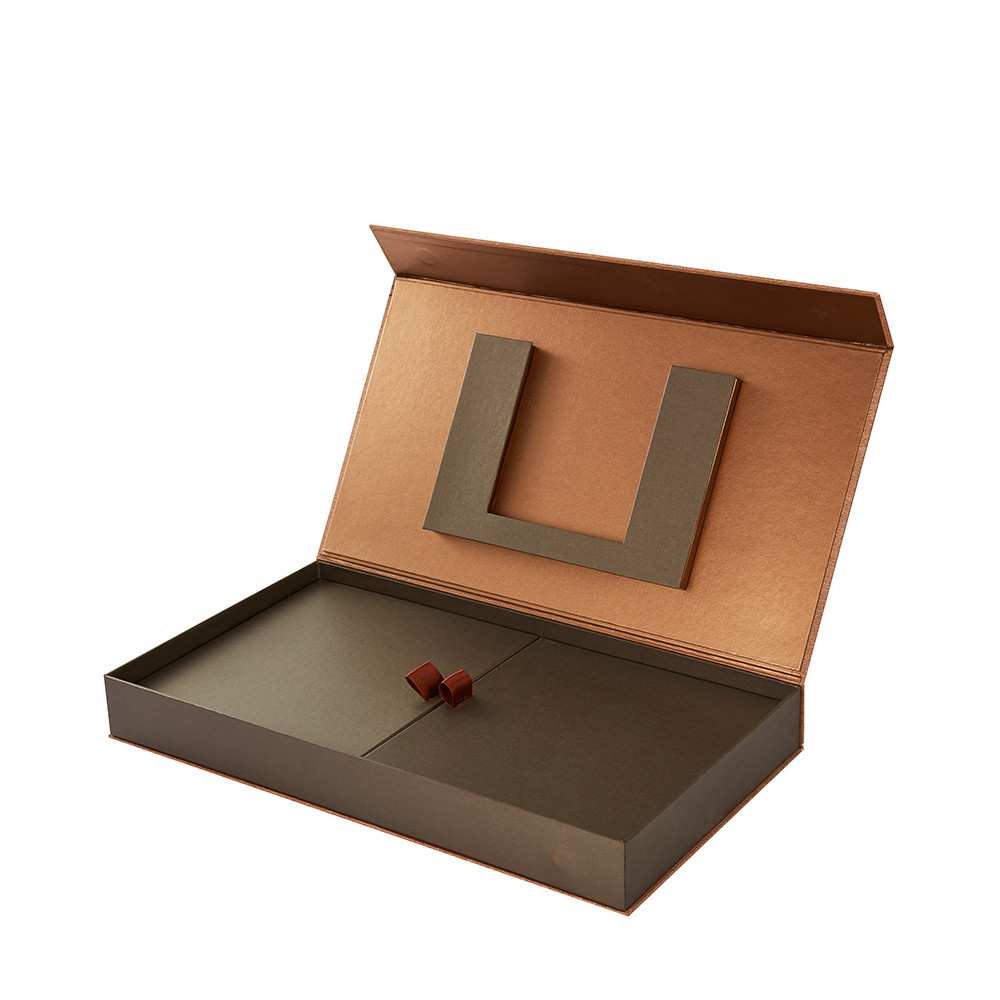
How Do Structure and Size Change the Minimum Order Quantity?
How Do Materials and Finishing Move the MOQ?

Should You Choose a Lower MOQ or a Lower Unit Price?
What Else Should You Compare Besides the MOQ Number?
Quotation line
What to ask
Why it matters
Tooling and plate charges
One-off or included at MOQ? Reusable on a repeat order?
A one-off die is cheap across three runs and expensive for a single run
Sampling
Free white sample? Printed pre-production sample charged?
Budget two rounds; the second sample is often the one that matters
Price tiers
Unit price at 500, 1,000, 3,000 and 5,000 pcs
Shows the real cost curve and where it flattens
Lead time
Working days from sample approval, not from inquiry
Insert tooling and peak capacity are the usual delays
Inspection
ISO 2859-1 AQL level and defect classes
A cheap run with a loose standard can cost more in rework
Freight
Flat-packed versus assembled, carton count, pallet height
A collapsible structure can ship many times more boxes per container
How Can Small Brands Reach a Reasonable MOQ?
The MOQ Versus Lead Time Calculation
Common MOQ Mistakes Buyers Make
What We Recommend for a First Custom Run

How DHP Boxes Handles Minimum Order Quantities
Frequently Asked Questions
What is a reasonable MOQ for custom packaging boxes?
Is 500 pieces too small an order for a custom rigid box?
Does the MOQ include the sample?
Can I get a lower MOQ on a repeat order?
How does MOQ affect the unit price?
Is a low MOQ always the cheaper route?
Final takeaway: how DHP Boxes can help
