
How to Design Packaging That Creates a Premium Unboxing Experience
A premium unboxing experience is the part of a product a buyer can describe months later: the weight of the lid, the small resistance before a magnet lets go, the moment the doors swing open and the product is already staged, lit and waiting. It is not a decorative wrapper around a purchase — it is the physical handover of brand trust, and it happens in the ten seconds before the product is even touched.
This guide is written by the team at DHP Boxes for brand owners, DTC founders, retail buyers and packaging designers who need to turn that feeling into a specification that a factory can quote and repeat. It covers the anatomy of a premium reveal, how to choose a structure around the opening sequence, materials and finishing that read expensive without shouting, inserts that hold the product exactly, the sampling and QC route to mass production, and the cost, MOQ and lead-time decisions that decide whether the box arrives before the launch.
What Is a Premium Unboxing Experience — and Why Does It Sell?
A premium unboxing experience is the designed sequence that takes a buyer from a closed parcel to a presented product: what they see, touch, and what resists before it releases. The product is the payoff; the packaging is the choreography that delivers it.
It sells because it does what advertising cannot: a photograph claims quality, a heavy lid with a controlled drop proves it. In unboxing videos the box is the brand’s first frame.
It also protects the margin: the same rigid box cushions the product in transit and gives the buyer a reason to keep it.
What Are the Five Stages of a Premium Reveal?
Most high-end openings follow the same rhythm; design each stage deliberately and the box feels considered.
| Stage | What the buyer experiences | What controls it |
|---|---|---|
| The first impression | A solid package that carries its weight in one hand | Rigid board thickness, outer carton choice, top-surface finishing |
| The breach | The deliberate resistance before it opens | Magnetic closure strength, friction-fit clearance, ribbon or tear strip |
| The reveal | The product already presented, not buried | Structure and opening direction: doors, lid, drawer or flap |
| The touch | Textures under the fingers as the product is lifted | Lining material, wrap paper, edge folding, insert surface |
| The keepsake | The decision to keep the box rather than bin it | Structural rigidity, printed story, secondary compartments, reusability |
Which Box Structure Suits Your Opening Sequence?
The structure determines the reveal, so choose it around the product and the moment of opening rather than a reference image.
| Structure | Opening sequence | Strongest fit |
|---|---|---|
| Double-door rigid box | Two front panels swing outward, revealing a lit or staged interior | Perfume, serums, gift sets, limited editions |
| Lid-and-base box | Lid lifts clear in one move | Classic single-product presentation, wine, candles |
| Magnetic book-style box | The cover falls open like a book, product lying flat | Watches, jewelry, long or flat items |
| Drawer or sliding box | The tray slides out from a sleeve | Small bottles, samples, sample and discovery sets |
| Flap-top rigid box | A hinged lid with an extend flap stays open on a counter | Retail counters, in-store demonstration |
| Collapsible rigid box | Same reveal, assembled at the warehouse | DTC brands shipping flat to reduce freight |
Which Structure Gives the Most Dramatic Reveal?
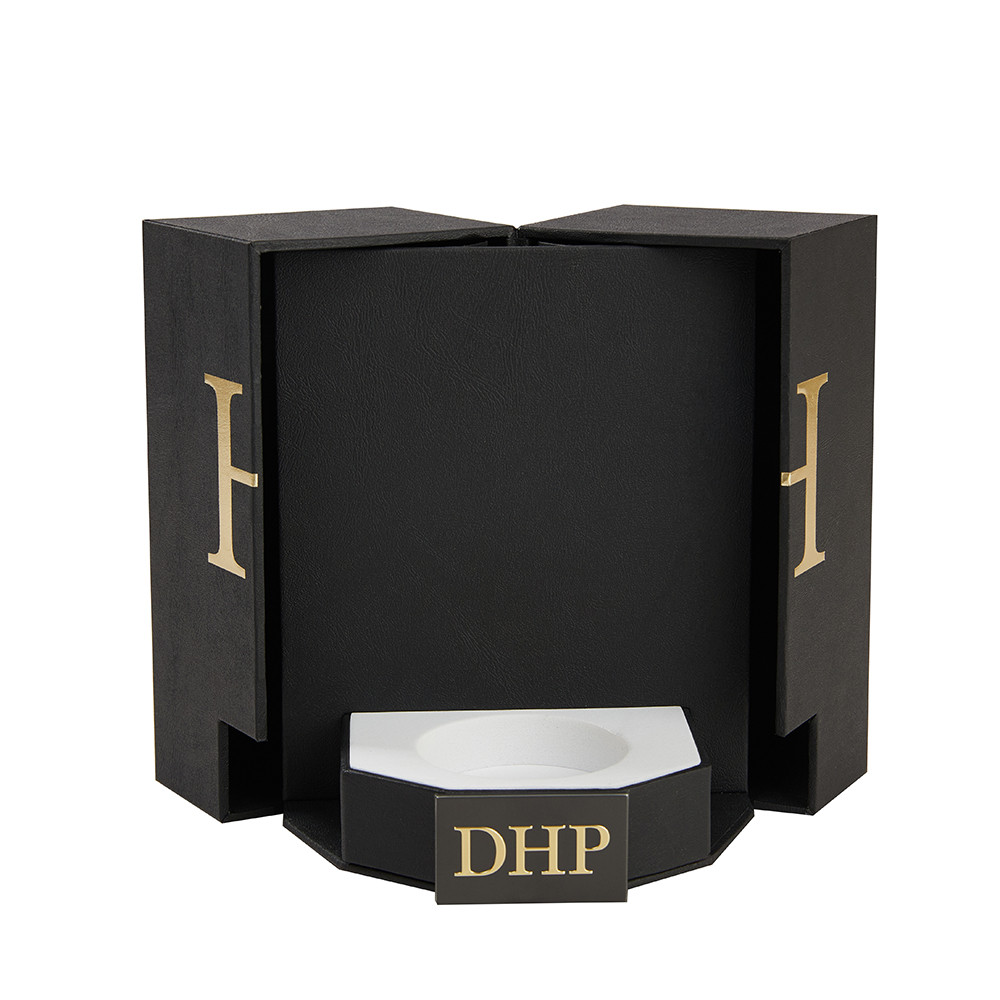
The double-door box is the most theatrical format we manufacture: two rigid panels hinged to a main body, held closed by hidden magnets, opening in one wide gesture.
That gesture is also the format's risk. Doors are hinged assemblies, so the alignment, the magnet position and the clearance at the centre join all have to be engineered together. A well-made double-door box shuts with two soft clicks and no visible gap; a poorly made one shows an uneven seam and a door that hangs.
We build them in 2mm cardboard wrapped in specialty paper, with gold foil, embossing and an optional LED module under the base.

Which Materials Make the Box Feel Premium Before It Opens?
Weight and friction signal quality in the hand: weight from the board, friction from the wrap.
- 2mm greyboard or cardboard core — the standard rigid-box body. It resists flexing when lifted by one corner, which is what makes the box feel dense.
- Specialty paper wrap — textured, uncoated papers with a fine grain or linen feel. They absorb light rather than reflecting it, which reads as quieter and more expensive than gloss.
- Recycled board with FSC-certified wrap — for brands with a sustainability commitment to back up.
Inside, microfibre is softer on polished glass and metal; flocked paper gives a dry, matte touch at lower cost. Insist on a wrapped tray, not a raw greyboard edge.
Which Finishing Techniques Support the Reveal Instead of Competing With It?
Finishing should draw the eye to one place and then get out of the way, following the order of the reveal.
Outside, a matte lamination or anti-scratch film protects a dark wrap from fingerprints. One foil-stamped logo and one embossed crest give depth without noise.
Inside, restraint wins: a foil line along the door edge or a debossed logo on the tray. Avoid four finishes in one box — registration drift on a hand-wrapped door is very visible.
How Do You Design an Insert That Presents the Product Perfectly?
The insert holds the product still in transit and presents it at the right angle on opening; those goals can conflict, which is why it is the most revised part of a premium project.
| Insert type | Feel on opening | Best for |
|---|---|---|
| EVA foam, wrapped | Solid, precise, premium | Heavy or irregular items: bottles, jars, electronics |
| Paperboard die-cut tray | Clean, recyclable, economical | Light products, retail and eco-led lines |
| Moulded paper pulp | Natural and tactile | Plastic-free commitments, curved bottles |
| Flocked or velvet-covered board | Soft, warm, jewellery-grade | Rings, watches, small luxury items |
| Fabric-wrapped platform | Raised stage, theatrical | Multi-piece gifts and sets |
We cut the cavity 1–2mm larger than the product on fragile glass, with a finger notch or ribbon pull. In a set, each piece needs its own cavity and pull.
The route from concept to carton runs through four checkpoints:
Structural design and dieline
Product dimensions, weight and opening direction become a dieline; clearance, hinge position and magnet pockets are fixed here.
White sample and fit proof
A plain white box with the intended insert and the real product inside — the cheapest place to settle cavity sizing and lid tolerance.
Printed pre-production sample
Final wrap, lamination, foil, emboss depth and colour are proofed on the production construction, with door edges and inside panels checked as closely as the front.
Mass production and AQL inspection
Printing, lamination, die-cutting, foil stamping, wrapping, insert building and assembly run in sequence, then cartons are inspected against ISO 2859-1 AQL levels agreed in advance.
The defects worth watching are structural: corner wrap wrinkles, glue marks, a lid proud on one side, doors that do not close flush, loose magnets and an over-tight insert.
How Does the Opening Change Between Retail, DTC and Gifting?
A boutique reveal happens in a salesperson's hands and can afford a slow sequence — a double-door with LED lighting earns its assembly because someone talks the buyer through it. A DTC reveal happens alone, with a craft knife, so the outer mailer is part of the experience: print the inner lid. A gift reveal puts weight on the lid, opened from the top.
What Drives the Cost of a Premium Unboxing Box?
Four inputs dominate the price. Hand assembly is the largest: a double-door box with LED lighting and a multi-layer insert passes through more hands than a plain lid-and-base box. Wrap and lining come next, because specialty paper is priced by the metre. Each finishing pass adds cost and handling, and insert complexity is the fourth lever.
Tooling — box die, insert die and printing plates — is a one-off, retained for reorders, which is why the second run costs less.

What MOQ and Lead Time Should a Launch Plan For?
Custom unboxing boxes are hand-assembled, so the minimum order reflects labour as well as material. Our standard floor for a rigid presentation box is 500 pieces, and new die-cut tooling or a complex LED assembly can sit above that. Ask for a price ladder rather than a single unit price, because the cost per box falls steeply between the first tier and the second.
| Planning item | Typical position | What to confirm in writing |
|---|---|---|
| Minimum order quantity | From 500 pcs for a standard rigid box | Whether insert tooling or LED assembly raises the floor |
| Sample development | About 5–7 days | Whether sample and tooling charges are credited on order |
| Mass production | About 25–30 days after sample approval | That the clock starts at written approval, not at inquiry |
| Tooling | Box die, insert die, plates | That tooling is held for reorders |
| Inspection | ISO 2859-1 AQL | Acceptance level and defect list |
| Freight | Assembled or flat-packed | Carton count, pallet height, dimensional weight |
Work backwards from the shelf date: sampling, one printed-sample approval, 25–30 days of production, then freight.
How Can a Premium Unboxing Experience Be More Sustainable?
Keep the box paper-based: FSC-certified specialty paper over recycled greyboard, a paperboard or moulded pulp insert, water-based inks and a deboss instead of foil. It recycles in ordinary paper streams and still feels considered.
Where padding is needed, use a thin EVA layer under a paper tray rather than a solid foam block. Magnets must be removed before pulping, so some brands choose a friction-fit lid. Making the box worth keeping is itself a strategy: a box in the home never becomes waste.
Frequently Asked Questions
What makes an unboxing experience feel premium?
Weight, controlled resistance and presentation. A rigid 2mm board, a damped closure, a soft lining and an insert holding the product at the right angle do more than any amount of print. The product should already be presented when the box opens.
How much does a custom premium gift box cost?
It depends on structure, wrap, lining, finishing and insert. A lid-and-base box with a printed wrap sits at the accessible end; a double-door box with LED lighting, gold foil and an EVA insert at the top.
What is the minimum order quantity for custom unboxing boxes?
From 500 pieces for a standard rigid box. New tooling, LED modules or heavily hand-finished details can raise the floor; a reorder on an existing die can go lower.
How long does production take?
Sample development is about 5–7 days; mass production about 25–30 days after printed-sample approval, plus freight. Peak season and complex LED assembly are the usual delays.
Do you offer OEM and ODM unboxing packaging?
Yes. We develop structures and inserts from a drawing, a reference box or a physical product, prove them with a white sample, and work from supplied artwork or design in house.
Final takeaway: how DHP Boxes can help
A premium unboxing experience is decided in the sequence, not the surface. Start with the five stages, hold the product with an insert cut around the real item, and spend the finishing budget on one foil, one emboss and a durable lamination.
DHP Boxes is a custom packaging manufacturer with 20+ years of experience, a 10,000 m² factory and 200+ workers in China, producing double-door, magnetic book-style, drawer and collapsible rigid boxes for perfume, cosmetics, wine & spirits and jewelry brands worldwide. We handle structural design, inserts, prototyping, printing, finishing, assembly and AQL inspection in house, support OEM and ODM, offer free white samples, and state MOQ, tooling and lead time up front. Browse our custom packaging boxes, read more on the DHP Boxes blog, learn about our factory and team, or send us an inquiry with your product dimensions, quantity and target launch date.
