
How Custom Rigid Boxes Are Made: Factory Process | DHP
How Custom Rigid Boxes Are Made: Factory Production Process
Discover how custom rigid boxes are manufactured, from structural design and greyboard cutting to printing, V-grooving, wrapping, assembly and quality inspection. This factory-focused guide explains the manufacturing decisions behind premium rigid packaging.

Quick Answer: How Are Custom Rigid Boxes Manufactured?
Custom rigid boxes are made by cutting thick greyboard into structural components, preparing printed or decorative wrapping materials, forming the box structure, bonding the wrap to the board, installing inserts or closures, and inspecting the finished packaging. Depending on the design, production also involves V-grooving, lamination, foil stamping, embossing, magnetic closure installation and manual assembly. The exact manufacturing sequence varies with the box structure and finishing requirements.
What Is Rigid Box Manufacturing?
Rigid box manufacturing is the process of converting thick paperboard, decorative wrapping paper and other components into a finished packaging box that retains its structural shape.
Unlike folding cartons, which are generally produced from thinner paperboard and supplied flat, conventional rigid boxes use a relatively thick board core. The board is covered with printed or specialty material to create a finished surface.
This construction is widely used for luxury perfume packaging, cosmetics, watches, jewelry, whisky gift boxes, electronics and premium presentation sets.
The rigid board provides structural support, while the outer wrap creates the desired visual and tactile appearance. Additional components such as magnets, ribbons, hinges, paperboard dividers and EVA inserts determine how the packaging opens, closes and protects its contents.
Because every custom design has different dimensions and finishing requirements, rigid box production combines machine-based operations with skilled assembly and inspection.
Custom Rigid Box Manufacturing Process: Overview
The production workflow below represents the main stages involved in custom rigid box manufacturing. Some operations run in parallel, and their order may change depending on the structure and materials.
At DHP Boxes, the published manufacturing workflow covers design, prototype development, printing, finishing, die-cutting, assembly, quality control and delivery. Our manufacturing approach focuses on coordinating these stages around the approved packaging specification.
Step 1: Structural Design and Dieline Development
The manufacturing process begins with understanding the product that will be placed inside the box.
Packaging engineers evaluate product dimensions, weight, fragility, accessories, presentation orientation and opening requirements. These details influence the internal box size, board structure, closure design and insert configuration.
Choosing the Box Structure
Common options include magnetic closure rigid boxes, book-style boxes, drawer boxes, lid-and-base boxes, shoulder-and-neck boxes and double-door presentation boxes.
Each structure has different manufacturing requirements. For example, a magnetic closure box needs sufficient space for concealed magnets and careful alignment between the lid and base. A drawer box requires suitable clearance for smooth sliding. A double-door box requires balanced door movement and accurate positioning.
Developing the Dieline
A structural dieline defines the cutting, folding and assembly geometry of the packaging components. It must account for the board thickness, wrapping material, corner construction and intended final dimensions.
Unlike simple paper cartons, rigid boxes often use separate greyboard components and wrapping sheets. The structural design must therefore consider both the board geometry and the material that will cover it.
Step 2: White Samples and Printed Prototypes
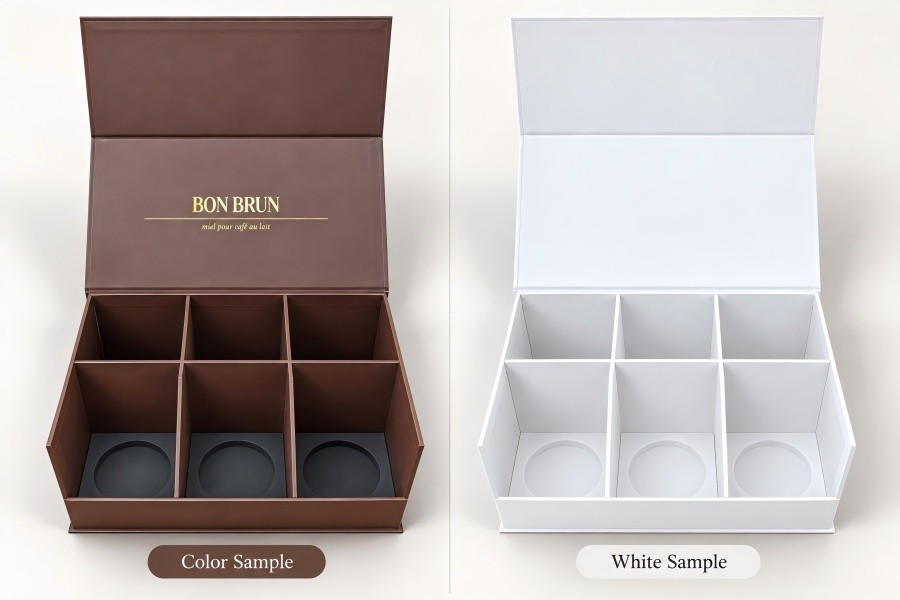
Before mass production, physical samples help verify whether the proposed structure works as intended.
White Sample
A white sample is primarily used to check structural dimensions, product fit, lid movement, insert positioning and overall assembly feasibility.
Printed Sample
A printed prototype helps evaluate artwork, colors, decorative materials, finishing effects and the overall presentation.
At DHP Boxes, sample development is part of the published manufacturing process. The factory presents sample-making and digital printing equipment among its production capabilities.
For color-sensitive projects, buyers should confirm whether the sample uses the same printing method and substrate intended for mass production. A digital prototype may not reproduce an offset-printed production result exactly.
Step 3: Preparing Greyboard, Wrapping Paper and Inserts
Material preparation influences structural strength, print quality, wrapping accuracy and the finished appearance.
Greyboard: The Structural Core
Greyboard, sometimes called chipboard in packaging applications, forms the main structural body of many rigid boxes.
Its thickness and density should be selected according to the box size, product weight, construction and expected handling conditions.
Using excessively thick board can increase weight, material cost and assembly difficulty. Using insufficiently rigid board can lead to deformation or inadequate support.
The appropriate specification should be confirmed through structural assessment and physical sampling rather than assuming one thickness suits every product.
Exterior Wrapping Materials
Coated art paper is frequently selected for full-color printed designs. Textured specialty paper, colored paper and other decorative substrates are used when the desired presentation emphasizes tactile character or material appearance.
Paper grain direction, surface texture, coating and flexibility can influence corner wrapping and folding performance.
Insert Materials
Insert preparation may involve die-cut paperboard, EVA foam, sponge, molded pulp or other materials. The choice depends on product protection, appearance, positioning, sustainability requirements and cost.
Step 4: Printing and Surface Finishing
Printing and finishing are usually performed on the flat wrapping material before it is bonded to the rigid board structure.
Offset Printing
Offset printing is commonly used for high-quality packaging graphics, detailed illustrations and repeat production. It supports CMYK artwork and, where specified, Pantone spot colors.
DHP Boxes publicly lists Heidelberg printing equipment as part of its factory capabilities.
Digital Printing
Digital printing can support prototype development and projects where flexible artwork changes are useful. The final production method should be selected according to the quantity, substrate and required appearance.
Lamination and Decorative Finishes
Depending on the design, printed sheets may receive matte, gloss or soft-touch lamination. Other finishing options include hot foil stamping, embossing, debossing and Spot UV.
These processes are not interchangeable. Lamination creates a surface film, foil stamping transfers a decorative foil, and embossing or debossing changes the surface relief.
Spot UV applies a localized glossy coating, whereas UV printing refers to a printing method that uses ultraviolet curing. Buyers should specify the intended process clearly.
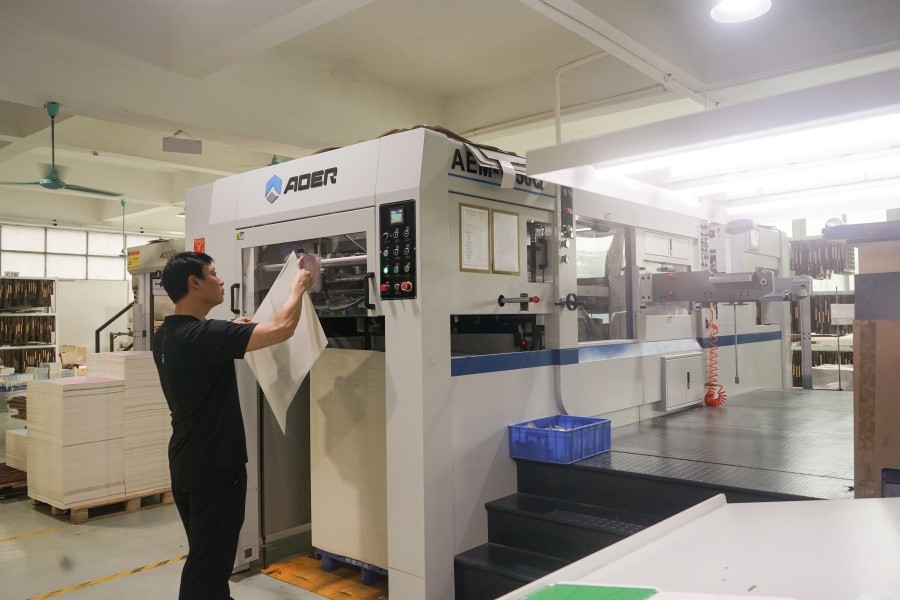
For additional manufacturing options, explore DHP's printing and packaging capabilities.
Step 5: Greyboard Cutting, Die-Cutting and V-Grooving
After the structure and materials are approved, the greyboard is prepared according to the required component dimensions.
Precision Greyboard Cutting
Cutting accuracy is important because dimensional errors can affect lid fit, box symmetry and insert positioning. Depending on the structure, board components may be cut individually or processed through suitable converting equipment.
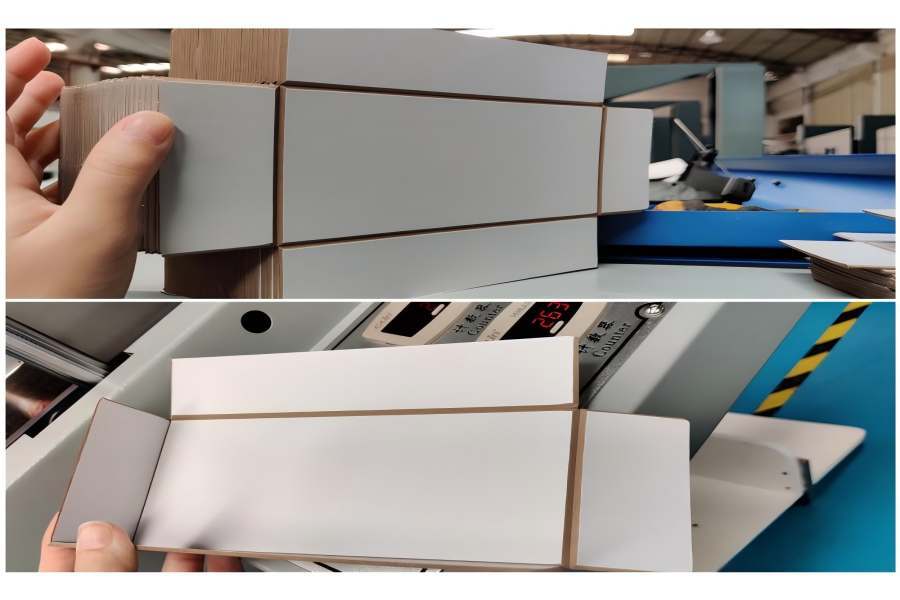
What Is V-Grooving?
V-grooving removes a controlled V-shaped channel from one side of the board, allowing it to fold more sharply along the groove.
This technique is particularly useful when a rigid box requires crisp edges and defined corners. The groove geometry and remaining board thickness must be appropriate for the material and folding design.
Not every rigid box requires V-grooving. Some constructions use separately cut board panels joined and wrapped through other forming methods.
For manufacturers, the key is choosing a cutting and folding method that achieves the intended appearance while maintaining adequate structural integrity.
Step 6: Rigid Box Forming, Gluing and Paper Wrapping
Box forming and wrapping transform flat materials into a finished rigid packaging structure.
Depending on the design, board panels are assembled into the required shape, adhesive is applied, and the printed or decorative paper is positioned and wrapped around the board.
Forming the Rigid Structure
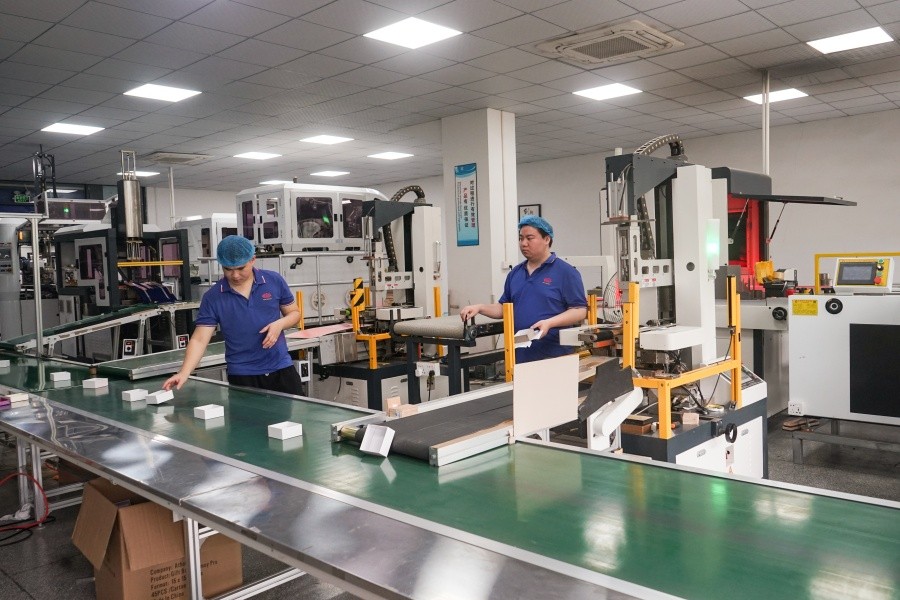
Automatic rigid box making equipment can assist with repeatable forming operations for suitable box designs. Complex structures or decorative features may require additional manual operations.
Applying the Wrapping Material
The wrapping sheet must be positioned accurately to maintain consistent borders, artwork placement and corner appearance.
Incorrect positioning can result in exposed greyboard, uneven edges, wrinkles or misaligned graphics.
Adhesive and Pressing
Adhesive selection and application influence bonding strength and surface appearance. Too much adhesive may cause marks or deformation, while inadequate bonding can result in lifting or separation.
Pressing and smoothing operations help establish contact between the wrapping material and board. The exact equipment and method depend on the construction.
Step 7: Installing Magnets, Inserts and Accessories
After the main box components are formed, additional assembly operations complete the required packaging structure.
Magnetic Closures
For magnetic rigid boxes, magnets must be positioned correctly so the lid closes in the intended location. Incorrect alignment or polarity can affect closure performance.
Custom Inserts
Inserts are fitted according to the product dimensions and presentation requirements. A perfume bottle, watch, jewelry item or electronics set may require different cavity geometry and support.
Insert depth, finger access, pressure points and removal convenience should be evaluated during sampling.
Additional Components
Some designs incorporate ribbons, handles, decorative panels, internal compartments, windows or other accessories. These components introduce additional assembly and inspection requirements.
For complex packaging such as double-door boxes, the relationship between both doors, the closure mechanism and the insert is especially important.
Step 8: Quality Control During Rigid Box Production
Quality control is not a single operation performed at the end of manufacturing. It involves checking materials, printing, structure, assembly and finished appearance against the approved specification.
DHP's published manufacturing information describes incoming material checks, in-process inspection and final quality control.
| Inspection Stage | What Is Checked | Potential Defect |
|---|---|---|
| Incoming Materials | Board, paper and material condition | Warping, visible damage, inconsistent material |
| Printing | Color, registration and print appearance | Color variation, misregistration, ink defects |
| Cutting | Dimensions and component accuracy | Incorrect size, uneven cutting |
| Wrapping | Corner quality, alignment and adhesion | Wrinkles, exposed board, glue marks |
| Assembly | Opening, closure and insert positioning | Misaligned lid, loose insert, closure problems |
| Final Inspection | Overall appearance and packing conformity | Scratches, deformation, missing components |
Color Consistency
For important brand colors, production should be compared against an approved physical reference under agreed viewing conditions. Paper characteristics and finishing can affect perceived color.
Structural Consistency
Box dimensions, lid alignment, corner quality and closure movement should be evaluated using suitable inspection methods.
Inspection Acceptance Criteria
Sampling plans and acceptance limits should be agreed according to the project. AQL-based inspection may be used, but no single acceptance level should be assumed for every order.
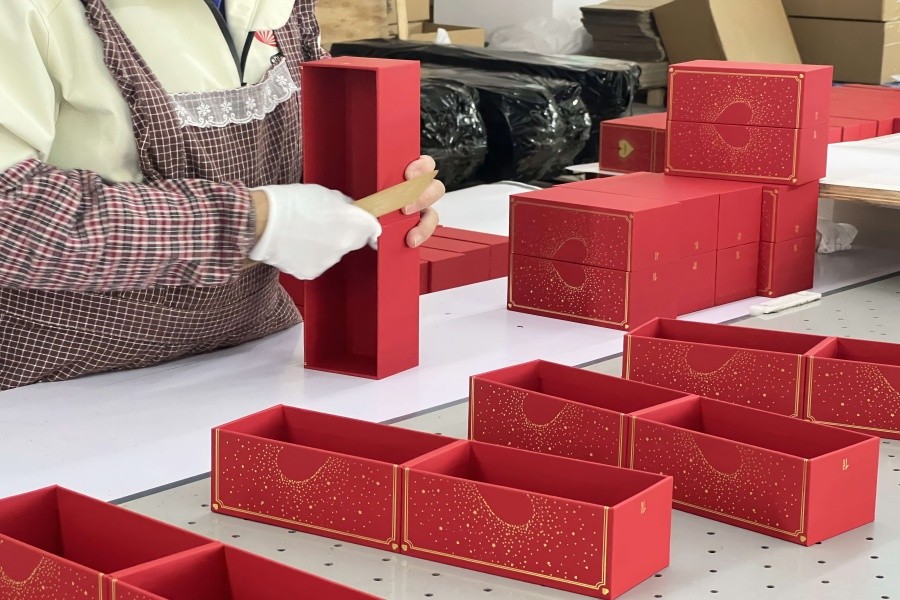
Step 9: Protective Packing and International Shipping
Finished rigid boxes must be protected during storage, handling and transportation. Premium wrapping materials and decorative finishes can be vulnerable to scratches, abrasion, compression and moisture.
Depending on the box design, packing methods may include protective sheets, individual wrapping, inner cartons, export cartons and additional cushioning or corner protection.
Carton dimensions, loading arrangements and stacking conditions should be considered alongside product weight and shipping method.
For sea freight, humidity exposure and prolonged transit can introduce additional risks. The appropriate protective measures should be selected according to the material and shipping conditions.
Transit testing may be considered where required by the buyer. The test method and acceptance criteria should be confirmed before production.
Inside DHP Boxes: Manufacturing Equipment and Factory Capabilities
DHP Boxes is a China-based custom rigid box manufacturer serving brands that require luxury paper packaging, structural customization and production support.
Our published factory equipment includes Heidelberg printing presses, automatic rigid box making machines, die-cutting machines, gluing machines, hot foil stamping machines and sample-making equipment.
Heidelberg Printing Equipment
Supports printed wrapping materials and detailed graphics for premium packaging projects.
Automatic Rigid Box Machines
Support forming operations for suitable rigid box constructions and repeatable production.
Die-Cutting Equipment
Processes packaging components according to the approved cutting and structural design.
Hot Foil Stamping Equipment
Creates decorative metallic or other specified foil effects on compatible packaging materials.
Digital Printing Equipment
Supports flexible artwork production and selected prototype or short-run applications.
Sample-Making Equipment
Supports structural testing and physical sample development before mass production.
Buyers can review DHP's manufacturing facilities and custom packaging capabilities for additional information.
Common Manufacturing Challenges and How They Are Addressed
1. Uneven or Exposed Corners
Corner defects can result from inaccurate board preparation, unsuitable wrapping allowances or inconsistent forming. Structural sampling and controlled cutting and wrapping help reduce these problems.
2. Color Differences Between Samples and Production
Differences in printing methods, paper substrates and finishing can influence color appearance. Buyers should approve an appropriate production reference and agree on color evaluation criteria.
3. Wrinkles and Glue Marks
Wrinkles and adhesive marks may occur when paper flexibility, adhesive application, positioning or pressing are unsuitable. The production method should be matched to the chosen material.
4. Magnetic Lid Misalignment
Magnet positioning, polarity and structural dimensions affect closure performance. These features should be checked during prototype development and production inspection.
5. Insert Fit Problems
An insert that is too tight may make the product difficult to remove. An insert that is too loose may allow unwanted movement. Product fit should be tested using an actual product or a dimensionally accurate reference.
6. Damage During Transportation
Scratches, crushed corners and deformation may result from insufficient protection or unsuitable carton loading. Export packing should be considered part of the manufacturing specification rather than an afterthought.
How Manufacturing Methods Differ by Rigid Box Structure
Not all rigid boxes follow identical assembly operations. The structure determines which manufacturing details require particular attention.
| Box Structure | Important Manufacturing Detail | Typical Application |
|---|---|---|
| Magnetic Closure Box | Magnet placement, polarity, lid alignment | Cosmetics, gifts, electronics |
| Book-Style Rigid Box | Spine flexibility, opening movement, panel alignment | Watches, jewelry, presentation sets |
| Drawer Rigid Box | Sliding clearance, sleeve fit, drawer stability | Beauty products, accessories |
| Lid-and-Base Box | Lid clearance, base strength, even wrapping | Perfume, chocolate, jewelry |
| Double-Door Box | Door symmetry, hinge movement, closure alignment | Whisky, tequila, premium gifts |
| Collapsible Rigid Box | Folding joints, adhesive or magnetic assembly points | Fashion, apparel, gift sets |
The most suitable construction depends on product dimensions, presentation requirements, shipping needs and budget. DHP develops custom packaging structures according to individual project specifications.
Why the Manufacturing Process Matters to Packaging Buyers
Understanding how rigid boxes are made helps procurement teams evaluate quotations, anticipate technical risks and communicate more effectively with manufacturers.
For example, a complex structure with multiple components may require more assembly operations than a conventional lid-and-base box. Specialty paper and multiple decorative finishes may also introduce additional setup and inspection requirements.
Instead of selecting a box solely by appearance, buyers should evaluate its construction, material suitability, production repeatability and protective performance.
When comparing factories, request relevant production evidence, inspect physical samples and confirm how the approved specification will be maintained during mass production.
For a broader supplier evaluation, read our guide to custom rigid box manufacturing in China.
Frequently Asked Questions About Rigid Box Manufacturing
How are custom rigid boxes made?
Custom rigid boxes are made by preparing thick board components, printing and finishing wrapping materials, forming the structure, applying the outer wrap, assembling inserts and closures, and inspecting the finished packaging.
What materials are used to manufacture rigid boxes?
Common materials include greyboard, coated art paper, specialty wrapping paper and suitable adhesives. Inserts may use paperboard, EVA, sponge, molded pulp or other materials.
What is V-grooving in rigid box production?
V-grooving is a board-processing technique that creates a V-shaped channel to facilitate sharper folds and more defined corners. It is used when appropriate for the box structure and board specification.
Are luxury rigid boxes made by machines or by hand?
Both methods may be used. Automatic equipment supports suitable repeatable operations, while manual assembly is useful for complex structures, decorative components and selected finishing tasks.
Why is greyboard thickness important?
Greyboard thickness affects rigidity, weight, folding behavior and construction. The appropriate specification depends on the box size, product weight and structural design.
Is printing completed before rigid box assembly?
For many paper-wrapped rigid boxes, printing and surface finishing are completed on flat sheets before the material is applied to the board. The exact order depends on the design and production method.
How do manufacturers control rigid box quality?
Quality control can include material inspection, printing checks, dimensional verification, wrapping inspection, closure testing, insert-fit checks and final inspection against the approved specification.
Can custom rigid boxes use recyclable materials?
Many rigid box designs can use paper-based components and paperboard inserts. Actual recyclability depends on material combinations, adhesives, decorative finishes, separation requirements and local recycling systems.
How long does rigid box production take?
Production time depends on the structure, quantity, materials, sample approval, finishing and factory scheduling. A manufacturer should provide a project-specific timeline covering each major production stage.
What manufacturing equipment does DHP Boxes use?
DHP's published factory capabilities include Heidelberg printing equipment, automatic rigid box making machines, die-cutting machines, gluing equipment, hot foil stamping machines and sample-making equipment.
Conclusion: From Structural Design to Finished Luxury Packaging
The rigid box manufacturing process is more than cutting paperboard and wrapping a box. It requires coordinated structural development, material selection, printing, converting, assembly and inspection.
For brands sourcing premium packaging, understanding these manufacturing stages helps establish realistic specifications, improve sample approval and reduce production risks.
As a custom rigid box manufacturer in China, DHP Boxes supports packaging development from initial concept and physical sampling through printing, manufacturing, quality inspection and delivery preparation.
