
How MOQ Affects Custom Packaging Box Pricing
When businesses start sourcing custom packaging, one of the first terms they encounter is MOQ — Minimum Order Quantity. Many buyers wonder why packaging suppliers require a minimum quantity and why prices change so much depending on order volume.
This guide explains the relationship between MOQ and packaging pricing from a manufacturing perspective, including cost structure, production setup, and strategies to optimize packaging costs when ordering custom boxes.
Table of Contents
1. What Is MOQ in Custom Packaging
2. Why Packaging Manufacturers Set MOQs
3. Fixed Costs vs Variable Costs in Packaging Production
4. Why Low MOQ Means Higher Price Per Box
5. MOQ and Packaging Strategy for Businesses
1. What Is MOQ in Custom Packaging
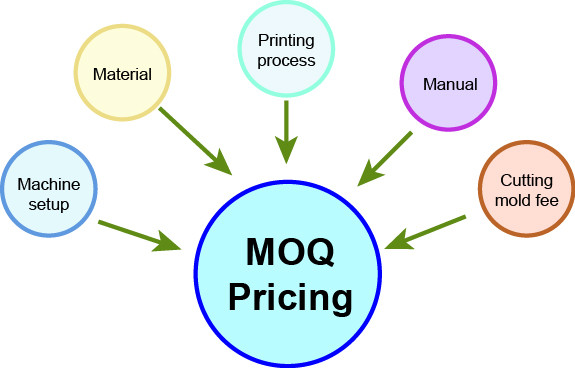
MOQ stands for Minimum Order Quantity, which refers to the lowest number of packaging boxes a manufacturer is willing to produce in a single order. In custom packaging manufacturing, MOQ is not a random number. It is determined by production setup costs, materials, printing processes, and labor requirements.
For example, a packaging factory may require a minimum order of 500 or 1,000 custom boxes because producing very small quantities is not cost-efficient. MOQ ensures that the production process remains economically viable for both the manufacturer and the customer.
2. Why Packaging Manufacturers Set MOQs
Custom packaging production involves multiple preparation steps before mass production begins. These steps include dieline creation, printing plate setup, machine calibration, material sourcing, and sample production. These processes require time, labor, and materials regardless of whether the order is 200 boxes or 20,000 boxes.
Because these setup procedures generate upfront costs, manufacturers set MOQ requirements to ensure these initial expenses can be covered. Without MOQ, producing very small batches would significantly increase production costs and reduce manufacturing efficiency.
3. Fixed Costs vs Variable Costs in Packaging Production
To understand MOQ pricing, it is important to understand the difference between fixed costs and variable costs in packaging manufacturing.
Fixed costs include machine setup, printing plates, cutting dies, sampling, and production preparation. These costs remain the same regardless of order quantity.
Variable costs include paper materials, ink, lamination, labor, assembly, and shipping costs, which increase as production quantity increases.
The total cost of custom packaging is a combination of fixed costs and variable costs. MOQ directly affects how fixed costs are distributed across each packaging box.

4. Why Low MOQ Means Higher Price Per Box
One of the most common questions buyers ask is why small orders are more expensive per unit. The reason is simple: fixed costs must be divided across fewer boxes.
If a factory spends money on machine setup, printing plates, and tooling, those costs must be distributed across the total number of boxes produced. When the order quantity is small, each box carries a larger portion of those setup costs. When the order quantity is large, the same setup cost is spread across many units, reducing the price per box.
This is why low MOQ orders typically have higher unit prices, while bulk orders benefit from lower unit costs.
5. MOQ and Packaging Strategy for Businesses
MOQ affects more than just unit pricing for manufacturers; it also influences a brand’s inventory management, cash flow, packaging design decisions, and product launch planning. Brands must balance lower unit costs with storage space, inventory risk, and upfront investment.6. How to Reduce Custom Packaging Costs with MOQ Planning
There are several strategies businesses can use to optimize packaging costs when dealing with MOQ requirements:
• Use standard box sizes instead of fully custom dimensions
• Simplify printing colors and finishing options
• Use digital printing for smaller runs
• Combine multiple products into one packaging design
• Plan long-term packaging orders instead of small repeated orders
• Work with a manufacturer that offers flexible MOQ options
These strategies can help businesses balance packaging cost, branding, and inventory management.
7. Choosing the Right Custom Packaging Manufacturer
Choosing an experienced packaging manufacturer is important when planning MOQ and pricing strategy. A professional packaging factory can help optimize box structure, materials, and printing methods to reduce costs while maintaining packaging quality.
As one of the custom packaging box manufacturers, DHP Factory provides custom packaging solutions including rigid boxes, folding cartons, and custom printed packaging with flexible MOQ options for different business sizes. Businesses can explore custom packaging solutions, box structures, and printing options through the company’s product pages to find the most cost-effective packaging solution for their products.
Working with an experienced manufacturer not only helps control packaging costs but also improves packaging design, product protection, and brand presentation.
Conclusion
MOQ plays a critical role in custom packaging box pricing because it determines how production setup costs are distributed across each unit. Low MOQ orders provide flexibility but result in higher unit costs, while large orders reduce cost per box through economies of scale and production efficiency.
By understanding how MOQ affects packaging costs, businesses can better plan packaging budgets, optimize order quantities, and improve overall cost efficiency while maintaining high-quality custom packaging.
