
Custom Packaging Box Dimensions: A B2B Buyer’s Checklist for Accurate Sizing
B2B Guide • Custom Packaging Engineering
Custom Packaging Box Dimensions: A B2B Buyer’s Checklist for Accurate Sizing
Learn how to specify L × W × H correctly, choose internal vs external dimensions, plan for inserts and tolerances, and avoid shipping surprises—so your custom boxes fit, protect, and scale smoothly from sample to mass production.
Stop rework
Prevent L/W/H confusion, insert mismatch, and artwork orientation issues.
Control costs
Reduce extra volume, sampling rounds, and freight inflation from oversizing.
Scale safely
Define tolerances and QC checkpoints that survive real production conditions.
RFQ faster
Use the copy/paste template to request a precise quote from DHP BOXES.
1) Why box dimensions cause costly mistakes in custom packaging
In B2B packaging, “size” isn’t just fit. It drives structural engineering, insert performance, print placement, and shipping costs. A few millimeters can decide whether a rigid lid closes cleanly, a drawer slides smoothly, or a bottle neck rubs the insert.
!What usually goes wrong
- Misread dimensions lead to wrong dielines and insert layouts.
- No clearance causes tight loading, scuffs, or crushed corners.
- Oversizing looks premium on paper but increases freight and weakens presentation.
- Artwork mismatch happens when the front panel orientation wasn’t defined.
Align terminology before sampling using DHP BOXES FAQ.
2) The sizing language that prevents confusion (L × W × H)
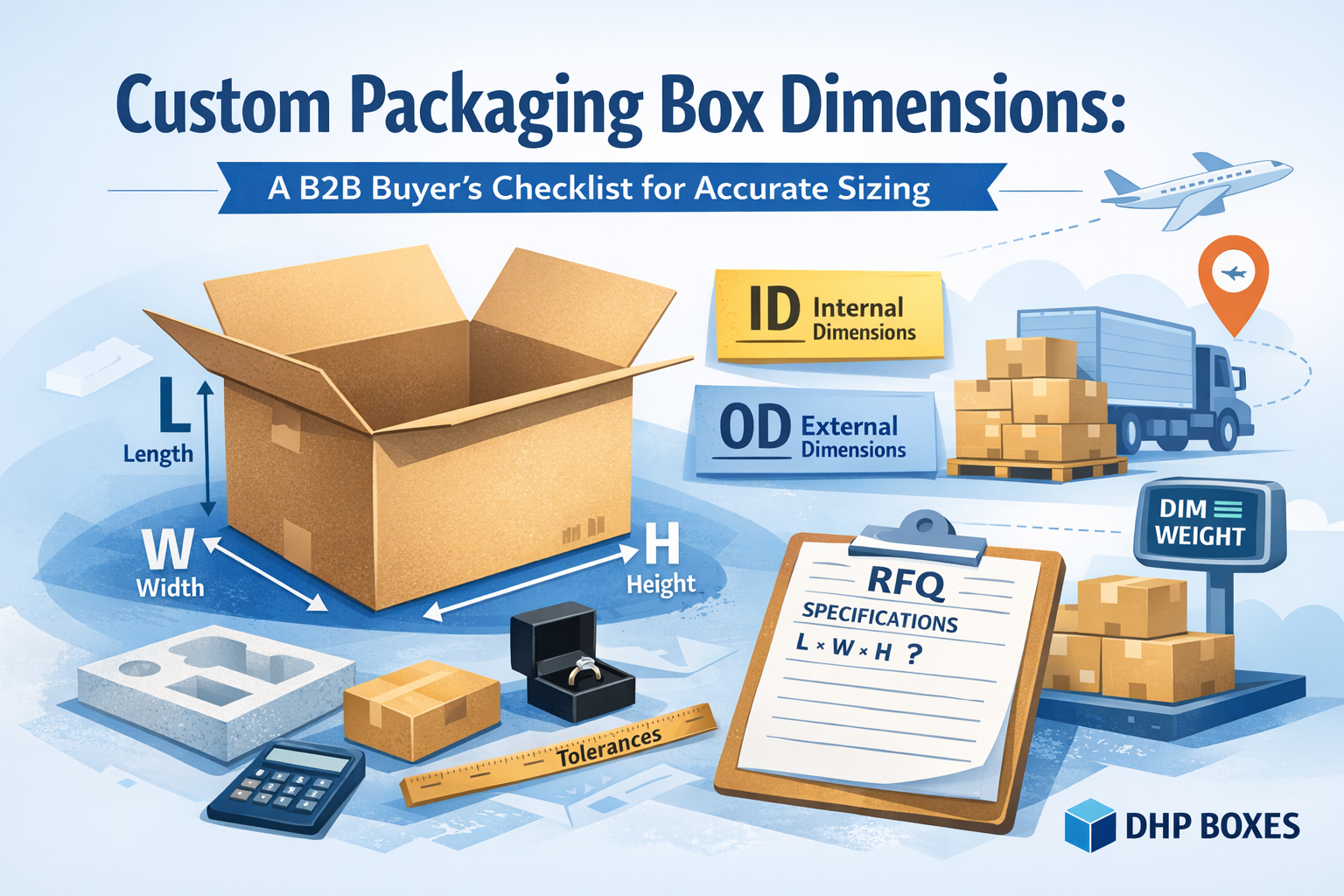
Most packaging workflows standardize on Length × Width × Height. The order matters. If your team swaps numbers, suppliers can interpret the box orientation differently, which impacts the dieline and insert layout.
✓How to measure (buyer-friendly method)
- Place the box in its normal display orientation.
- Measure the longest side on the opening face = Length (L).
- Measure the shorter side on the same face = Width (W).
- Measure bottom-to-top = Height (H) (sometimes called Depth).
| Dimension | Where to measure | Buyer note |
|---|---|---|
| L (Length) | Longest side of the opening face | Defines main panel orientation for dielines and inserts |
| W (Width) | Shorter side of the opening face | Often drives partitions and product positioning |
| H (Height/Depth) | Vertical measurement (bottom to top) | Confirm measured closed for lids and drawers |
3) Internal vs external dimensions (ID vs OD)
The biggest sizing disputes come from whether the size refers to usable space inside the box or the outside footprint.
Use internal dimensions when fit and inserts matter.
Use external dimensions when shipping and footprint are critical.
✓Best practice
Confirm both ID and OD on the approved sample sheet. This removes ambiguity and protects mass production consistency.
4) 10 common sizing mistakes and fixes
| Mistake | Impact | Fix |
|---|---|---|
| Not labeling ID vs OD | Wrong fit, wrong insert, wrong freight estimate | Write “ID” or “OD” next to every dimension |
| No clearance for inserts | Hard loading, scuffs, tight closing | Define product size + buffer + insert thickness |
| Ignoring board thickness | OD grows, lid feel changes | Lock board grade and confirm final OD on sample |
| Measuring open state | Production mismatch | Specify “measure closed” for lids and drawers |
| Unclear product orientation | Insert and branding orientation conflicts | State standing/lying, define the front panel |
| Forgetting accessories | Bulging, poor closing | Size for the full kit |
| Oversizing for premium | Higher freight, weaker presentation | Upgrade structure/finish instead of empty volume |
| Artwork before structure | Rework on panels and seams | Lock dieline first, then finalize artwork |
| No tolerance expectations | Sample ok, production drift | Agree tolerance and QC checkpoints |
| No cartonization plan | Unexpected freight increase | Request master carton spec + units/carton estimate |
5) Allowances & tolerances: clearance, thickness, inserts
Paperboard and wraps behave differently across folds, humidity, and assembly. A production-safe spec includes allowance decisions and a clear approval standard.
✓What to define before sampling
- Product clearance for loading and surface protection.
- Board thickness to predict OD and closing feel.
- Insert behavior based on EVA/foam/molded pulp/paperboard.
- Open/close cycle if the box will be reused or handled frequently.
If you need a quick fit check, reach out via DHP BOXES contact and request a blank sample.
6) Shipping reality: dimensional weight and OD impact
Freight cost is often driven by the space your shipment occupies. If the retail box grows, your master carton and pallet pattern can change. OD and cartonization planning help you avoid cost surprises after approval.
!What to request
When shipping cost matters, request unit OD, estimated units per master carton, carton OD, and packing method before final approval.
7) Factory-ready dimension spec (RFQ template)
Copy and paste this template into your RFQ to speed up accurate quoting.
Need a sizing recommendation for your product?
Share your product dimensions, preferred box type, and target quantity. DHP BOXES can validate ID/OD, insert clearance, and production-safe tolerances.
8) FAQs
Should I provide internal or external dimensions? ⌄
Provide internal dimensions (ID) for fit and inserts. Provide external dimensions (OD) for shelf footprint and shipping planning. Confirm both on the approved sample sheet for clarity.
Is “Depth” the same as “Height”? ⌄
Depth is often used interchangeably with height, but wording varies. Always write L × W × H and define the box display orientation.
Which dimensions matter for shipping? ⌄
Shipping calculations use the external size of the packed item and how units are packed into master cartons. Request cartonization guidance if freight is sensitive.
How much clearance should I leave for inserts? ⌄
Clearance depends on the product surface and insert material. Start with practical buffer, validate with a sample, then lock the final fit standard.
9) Why DHP BOXES for precision sizing
Reliable packaging comes from production-safe sizing standards and consistent execution. DHP BOXES supports custom structures, sample validation, and fit engineering so you can approve dimensions with confidence and scale without surprises.
Visit DHP BOXES, review FAQ, or send your dimension brief via Contact.
